
Creating a system you love shouldn't be difficult. The Acoustic Frontiers blog is here to help.

One of the most common “generic” acoustic treatment recommendations is to treat the reflection points. Unfortunately properly managing early reflected sounds is actually very complex psychoacoustically. Blindly treating reflection points with the wrong kind of products can make your sound worse. For a high performance high-end audio listening room, home recording studio or home theater there are many factors that need to be considered. These include the level, delay, spectral content and direction of reflections. Only then can a truly high performance acoustic treatment plan be designed and implemented.
Reflections can be divided into two groups: early reflected sounds and late reflected sounds.

The early reflected sound leaves the loudspeaker and then bounces off one of the boundaries of the room* before reaching the ears of the listener.
* these are: ceiling, floor, front wall behind speakers, rear wall behind listeners, left side wall, right side wall.
The speaker’s contribution to the early reflected sound is the frequency response at the off axis angles that represent the sound path from loudspeaker to boundary to listener. The fittings and furnishings of the room at the locations of the reflections change the spectral content of this sound on its way to the listener because objects like acoustic panels, carpet, ceiling tiles are all frequency dependent absorbers.
Late reflected sounds are those that arrive at the listener’s ears after multiple reflections. The speaker and room both contribute to what we hear as late reflected sounds. The speaker’s contribution is termed sound power. The room contributes it’s decay properties, both at mid-to-high frequencies (reverberation) and low frequencies (room resonances).
Early reflected sounds are much more important perceptually than late reflected sounds. This can be easily seen by examining a typical frequency response at the listening position and comparing it to the speaker measurements.
The following graphic was taken from Toole’s recent AES paper. Essentially it shows that you can use anechoic speaker measurements [graphic (a) on the chart below] to predict in room response [graphic (c)] with very good accuracy. In the region from 500Hz to 5kHz the response at the listening position closely follows the early-reflected predicted response [graphic (b)]. This early reflected response is calculated by averaging the speaker’s off axis response at the typical off axis angles for the floor, ceiling, side walls and back/front walls.
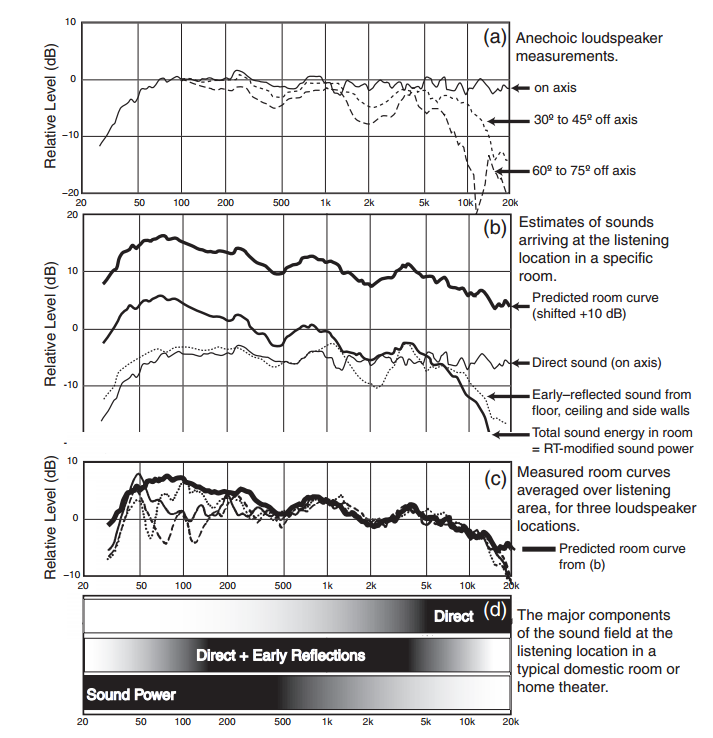
It should be clear that the off axis response of the speaker is a critical determinant of the frequency response at the listening position and therefore what you hear. Read our articles on speaker off axis response for more.
From this study you can see that late reflected sounds (“reverberation”) in the regions typically examined in RT60 studies (250Hz to 4kHz) are not critical to understanding the response at the listening position. This is important stuff, because many acousticians are still using RT60 as a primary measurement and prediction tool when designing the acoustics for small rooms.
Understanding mid and high frequency decay times should of course be part of a room acoustic optimization process, as they are a contributor to our perception of how “live” or “dead” a space is, but in our opinion they are very much a secondary concern. We’d much rather optimize the early reflected sounds if it means compromises to the late reflected sounds than the other way around.

One octave T60 measurements, from XTZ Room Analyzer II Pro
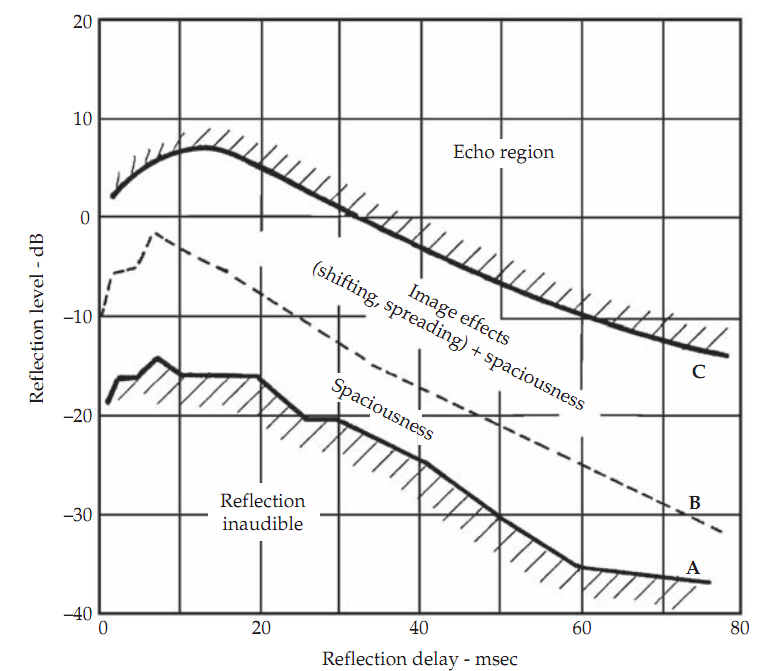
This is a very complex subject, so we’ll just scratch the surface here. How you perceive early reflected sounds depends on many things including:
Perceptual effects of reflections
For much more information on these topics the best reference is the Floyd Toole’s Sound Reproduction book!
The ETC is a type of acoustic measurement that shows reflection level and delay. Further information can be found in Acoustic Measurements 101. Here’s an example:

Energy time curve, from Room EQ Wizard
The most popular approach is simply to analyze the level of reflections on an ETC and compare these to the direct sound, setting a target for the reflections to be 10dB/15dB/30dB etc lower than the direct sound after a certain number of milliseconds (ms). These targets appear to have been arrived at by people reviewing the results of studies that examined the threshold at which reflections caused perceptual effects and then setting the allowable level of reflections to be below these values.
This approach is overly simplistic, since it does not examine whether these perceptual effects of the reflections are good, bad or neutral. Only through analysis of reflection direction, level, delay and spectral content can the impact of reflections on perceived sound be understood.
For more on the ETC read our article ‘Listening Room Reflections and the Energy Time Curve‘ over at Hi-Fi Zine.
Many people believe that reflected sounds cause audible comb filtering, and use that as a good reason to make the case to absorb all reflections.
They’ll typically present a case showing one signal (e.g. a 1kHz sine wave) and then the sum of the original signal and a delayed version of it. It’ll look something like this:

Example of comb filtering, SOS Magazine
This is fine as a thought experiment, but bears little resemblance to what actually occurs with our perception of early reflections for three reasons:
When we analyze room acoustics for a client one core part of the work is developing an approach to manage the early reflected sounds. It’s one of the three major pieces of work that goes into an acoustic treatment design – the other two being management of room mode resonances and late arriving energy.
Our approach starts at the speaker and works outward. The main factors considered are:
From this information we can predict the perceptual effect of each reflection, and develop a plan to address it. We may choose to leave reflections untouched, or we may absorb them completely, or diffuse them, or use hybrid absorber/diffusers to change the frequency response of the reflected sound.
As you can tell from this article, properly managing (“treating”) the early reflected sounds is very complex. It is not just a case of killing all peaks on the ETC as some acousticians would have you believe. Nor is it a case of generically adding absorbers and diffusers in some combination. We recommend starting at the speaker, considering its off axis response, and from there developing a complementary acoustic treatment plan.

Discover how Acoustic Frontiers engineered a family-friendly home theater with precise bass, full AV integration, and reference-quality performance.
"My goal was simple: create an experience that surpasses a commercial theater—and I believe we’ve achieved that." ~Jeff Mery, Bison HTA
"I could not be happier!" ~ A.S

Nyal Mellor, Founder, Acoustic Frontiers


Nyal Mellor
Author